
The Golden Trail World Series (GTWS) heads to South Korea for the final and decisive challenge of the season. In just one week’s time, Muju Trail will bring the 2026 campaign to a spectacular close with a Grand Finale set to push the world’s best trail runners to their limits.
Featuring one of the most technical and demanding courses in GTWS history, the race will decide who is crowned overall champion. Athletes will need to showcase their full range of skills across a spectacular and contrasting landscape, from high-altitude mountain terrain and dense conifer forests to the historic Buddhist temples of Deogyusan National Park.
Trail running is experiencing rapid growth across Asia, and South Korea is now joining this international momentum. In 2026, the GTWS lands in the country for the first time with an event specifically created to host the season’s Grand Finale. But the ambition extends far beyond the competition itself: to help drive the development of trail running in South Korea while putting Muju on the international sporting map, against the backdrop of the country’s bid to host the 2036 Olympic Games.
“This inaugural edition aims to lay the foundations for a long-term project, one capable of creating a lasting legacy and contributing to the growth of trail running in the country,” the organisers explain.
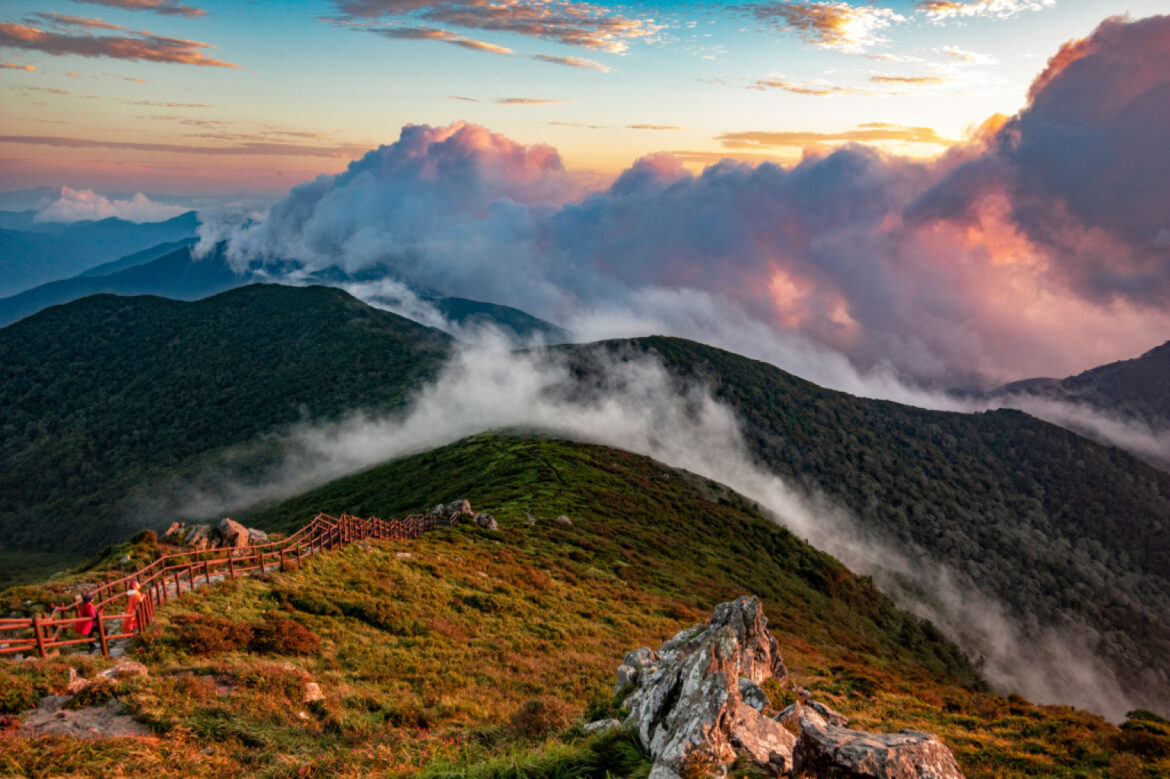
Located in the Jeonbuk Province, in the heart of South Korea, Muju is a destination deeply rooted in nature and mountain tourism. At the heart of the course lies Deogyusan National Park, one of the country’s most remarkable natural areas, renowned for the richness and diversity of its landscapes.
The course invites both runners and those following the action from afar to discover a different side of South Korea through its mountains, heritage and local communities. “The project was conceived not only as a sporting event, but as a new model for international sports tourism in Korea,” its creators explain.
Along the route, athletes will make their way through high-mountain landscapes transformed by the vibrant colours of autumn, cross dense conifer forests and pass historic landmarks that reflect the region’s rich cultural heritage.
Among them is the Baengnyeonsa Buddhist Temple, whose name translates as the “White Lotus Temple”. Its origins date back to the Silla dynasty, a period closely associated with the flourishing of Buddhist art and architecture in Korea.
According to legend, a white lotus flower bloomed on the site before the temple was built, inspiring its name. History, nature and sport come together along a course that makes the Muju Grand Finale much more than just a race.
In Buddhism, the lotus flower symbolises spiritual purity, enlightenment and the ability to rise above suffering. At Muju Trail, reaching the finish line will also require athletes to endure their fair share of suffering first. With 28,65 kilometres and 2,313 metres of elevation gain, the 2026 Golden Trail World Series Grand Finale features the most technical and demanding course of the season, and one of the toughest challenges in the history of the series.
The race will test the athletes’ versatility from the very first kilometre, combining climbs with gradients of up to 40% and technical descents where agility, confidence and concentration will be crucial, particularly as fatigue begins to take its toll.
At the heart of the event will be Muju Deogyusan Resort, one of South Korea’s largest ski resorts and the only one in the country located within a national park. From the Jumping Park, which will host both the start and finish, athletes will tackle an early and demanding climb towards Seolcheonbong. Fans will also be able to experience the action from higher up the mountain, with the gondola providing access to the summit area, where a large fan zone will offer a prime location to follow the race.
From Seolcheonbong, the course heads deep into the high mountains towards Hyangjeokbong, the highest point in Deogyusan National Park, at more than 1,600 metres above sea level. It will be the first major test of a race in which gaps could begin to open from the opening kilometres.
From there, the profile changes dramatically. The runners will leave the high-mountain ridgelines behind and descend towards Baengnyeonsa Temple, before climbing again via Jungbong towards Hyangjeokbong. After returning to the high peaks, they will descend once more to Baengnyeonsa, where a faster section will give athletes the opportunity to find their rhythm and speed again after the huge effort in the mountains.
But one final challenge will still remain. With two major high-mountain sections already in their legs, the athletes will face the climb towards Chilbong. Fatigue, steep gradients and the proximity of the finish will make this final ascent one of the defining moments of the race, with the potential to change everything before the fast final descent to the finish line.
EVERYTHING TO PLAY FOR
In the women’s competition, Madalina Florea (Scott) arrives in South Korea as the overall leader with 872 points, looking to successfully defend her title. After a season defined by consistency, her main challenger will be Caroline Kimutai (Salomon), who sits second on 806 points, just 66 behind the leader, and will be looking to take the crown after establishing herself as one of the standout performers of the season.
But the battle is far from a two-woman affair. Ruth Gitonga (Run2Gether On Trail), Barbora Bukovjan (Salomon), Hanna Groeber (Nike ACG) and Marie Nivet (Nike ACG) have all gained momentum during the second half of the season and arrive in Muju ready to seize every opportunity to move up the standings, challenge for the podium and, potentially, aim even higher.
In the men’s competition, defending champion Elhousine Elazzaoui (NNormal) will need to be at his very best if he is to retain the crown. Philemon Kiriago and Patrick Kipngeno (Run2Gether On Trail) have moved ahead in the standings during the closing stages of the season and arrive with 870 and 830 points respectively, compared with 824 for the Moroccan. Just 46 points separate the top three, leaving everything open for one last battle between the season’s leading contenders.
But there will be much more at stake in Muju than the titles alone. Every position will count in the fight to finish inside the overall top 10 and top 20. The top 20 athletes will share €231,000 in prize money, with €30,000 awarded to each of the men’s and women’s champions, while finishing the season inside the top 30 will secure logistical support to compete in the 2027 GTWS.
With so much at stake, every position and every point could make the difference. The Muju Trail Grand Finale will offer more points than any regular-season race, with 300 points awarded to the winners, compared with the usual 200.
On top of that, points will also be awarded across the three segments, meaning the race winner could collect up to 330 points in a single day. The uphill, downhill and sprint segments will therefore take on added significance, with the potential to shape both the race itself and the final overall standings.
The strategic importance of these segments has also influenced the way the local organisers have conceived the course: “An uphill or downhill section is not simply part of the course; it can become a competitive segment, with its own sporting narrative. In this way, every section can open a new battle and become a decisive moment in a race where every point counts.”
With this philosophy in mind, Muju Trail has created a course designed to test every facet of the world’s best trail runners while delivering an exciting spectacle for fans: “The Golden Trail World Series represent an approach to trail running that puts the emphasis on athletes’ versatility, explosiveness and speed, without losing sight of the spectator experience. We found this philosophy particularly appealing because we wanted to present trail running in Korea not only as an endurance challenge, but also as a sport capable of engaging a much broader audience.”
The women’s and men’s races will be broadcast live on 24 and 25 October respectively, starting at 1:00 PM KST. In Central Europe, the women’s race will start at 6:00 AM CET, while the men’s race will get underway at 5:00 AM CET due to the daylight-saving time change.
Fans will be able to follow the action on HBO Max, Eurosport and TNT Sports, as well as through an extensive network of official broadcasters.
“Thanks to the international coverage of the race, viewers will be able to follow the athletes as they make their way through Seolcheonbong, Hyangjeokbong, Baengnyeonsa, Jungbong and Chilbong, making the landscape itself part of the story of the race,”the organisers explain.
Beyond the sporting spectacle, the broadcast also represents an opportunity to showcase Muju and Deogyusan to an international audience and establish the region as a trail running destination. “Our long-term goal is for viewers to remember not only the results of the Grand Finale, but also Muju and Deogyusan as a recognisable international trail running destination. The GTWS gives Muju the opportunity to reach an international sports audience that would be extremely difficult for a new event to access independently,” the organisers add, with just one week to go until the Muju Trail Grand Final becomes a reality.