
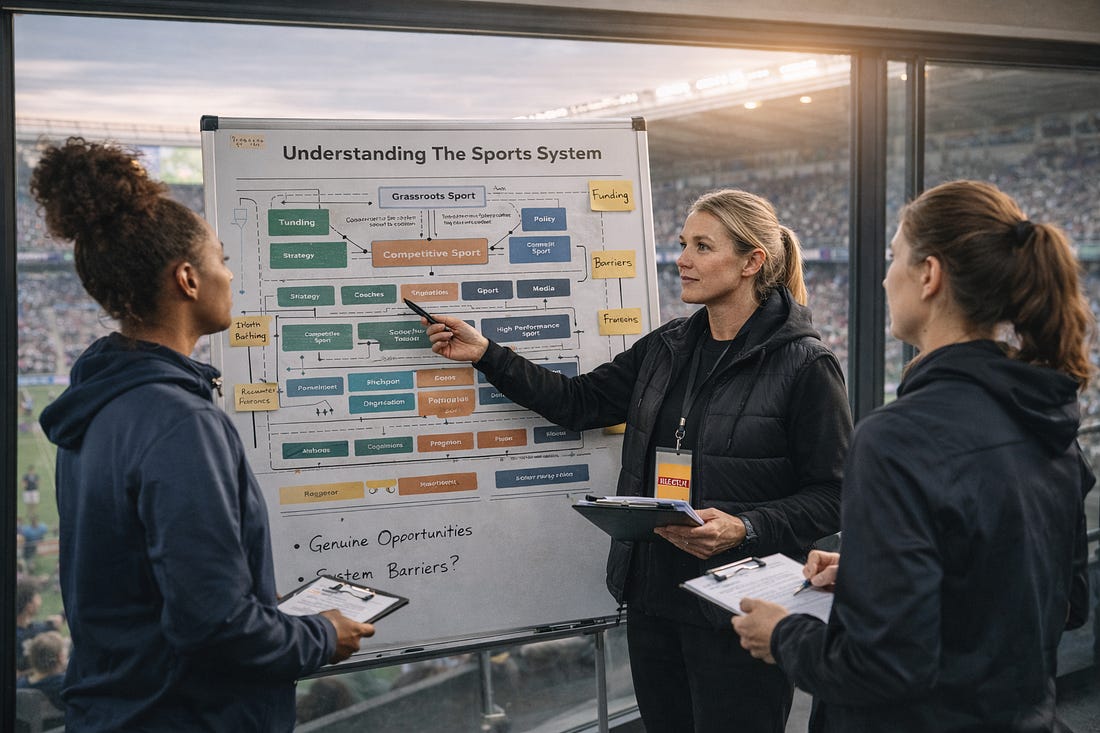
This week, as part of our new series of articles supporting coaches and organisations to take a more holistic approach to addressing the persistent lack of female coaches across sport, we turn our attention to the O of PRO – Opportunities.
This pillar focuses on the policies, procedures, and practices that shape pathways for female coaches and leaders. It looks beyond individual development and instead addresses the systemic barriers that influence who progresses, who is visible, and who ultimately gets access to opportunity.
By creating space for both coaches and organisations to step back and examine the bigger picture, the opportunities pillar helps identify what progression can actually look like — whether that is moving from assistant to head coach within a grassroots club, or reaching the highest level as Head Coach of a national team.
This week, we explore the lack of opportunity within the sports system for women, and how understanding the system itself allows you to see more clearly where the barriers exist — and, crucially, where genuine opportunities for progression might sit.
What Exactly Is the ‘System’?
Anyone involved in women’s sport will have no doubt come across the phrase “Fix the system, not the women.” It has become a powerful phrase for a simple but often misunderstood concept; that the persistent lack of female coaches is not a problem of women themselves, but a problem of sport itself.
At its core, the phrase challenges the long-standing tendency to locate the issue within women, i.e, their lack of confidence, ambition, resilience, or readiness — and instead directs attention towards the structures, cultures, and decision-making processes that shape who gets access to opportunity, progression, and power.
The intention of this phrase is not to dismiss the importance of individual development, but to push governing bodies and sports organisations away from blame-based thinking and towards a more holistic understanding of how the coaching system actually functions, and where the barriers for women lie.
The modern sports system is complex, multi-layered, and constantly evolving. Far removed from the early days of sport, before rationalisation (unified rules run by national governing bodies), sport was once little more than local groups organising competitions against neighbouring towns.
Today, sport operates as a complicated ecosystem, involving volunteers and paid staff, national and international governing bodies, clubs, brands, sponsors, agents, policies, money, commercial interests, athletes, and coaches… the list is almost endless. Decisions made in one part of the system ripple across many others, often in ways that are invisible to those trying to progress within it.
What the System Looks Like…
There have been many attempts to map the sports system over the years, and there is still no single agreed framework — particularly from a global perspective. Each country’s sports system operates differently, whether that is the US model shaped by NCAA-to-professional league pathways, the British system built around grassroots structures feeding into Olympic pathways, or smaller nations where opportunities may be more limited, informal, or resource-dependent.
While no two systems are the same, it is essential to understand your own. Only by getting to grips with the system you operate within can you clearly identify your potential pathways and where genuine opportunities for progression exist.
In 2024, researchers Joon-Ho Kang, J. Lucy Lee & Junemin Rhi, published a paper called The Comprehensive Sports System, which was an attempt to put the current system into a framework as a way of “categorising sport into four levels, emphasising the interconnectedness of systems and the importance of production and management components for sustainability”.
It structures the sports system into 4 layers including; recreational sport, grassroots sport, competitive sport and high performance sport, with each of those split into 10 components from participants themselves, through to the media.
Words and Images courtesy of Female Coaching Network

